


Outdoor public lighting has long troubled property managers, road construction teams and rural infrastructure builders with frequent power failures, high electricity bills, short lamp lifespan and unstable night illumination. Most ordinary street lights rely on complicated wired power supply, which brings huge construction costs, difficult maintenance and continuous energy consumption year after year. Many low-quality solar lamps on the market only work well on sunny days, fade quickly in rainy weather, and cannot maintain stable brightness throughout the whole night. Choosing reliable all-in-one solar street light can thoroughly solve these hidden pains that users ignore in daily use.
Different from traditional split-type solar lighting equipment, integrated solar street lights integrate photovoltaic panels, high-capacity lithium batteries, LED light sources and intelligent control systems into a compact whole. This structural advantage greatly reduces installation difficulty, avoids line aging faults, and adapts to complex outdoor environments including mountain roads, suburban communities, park paths and village thoroughfares. Professional lighting manufacturers like JC Solar Light strictly control raw material selection and production testing, ensuring each lamp meets harsh outdoor wind, rain, dust and temperature resistance standards that ordinary products cannot match.
A common misunderstanding among buyers is that all solar street lights have identical power-saving effects. In reality, photoelectric conversion efficiency, battery cycle life and light attenuation rate directly determine actual operating costs. Cheap inferior solar panels absorb weak sunlight inefficiently, batteries lose capacity rapidly after 6–12 months, and LED beads dim sharply, forcing users to replace lamps frequently and spend extra maintenance fees repeatedly. Practical long-term use data shows that qualified high-grade solar street lights can cut annual outdoor lighting expenses by more than 90% compared with mains-powered street lamps.
Bad weather adaptability is another deep-seated problem easily overlooked by consumers. Continuous cloudy days, heavy rain, low winter sunlight and high temperature exposure will severely restrict the working duration of ordinary solar lights. Unqualified products often shut down early at night, fail to light up continuously, or suffer battery damage caused by overcharging and over-discharging. Premium integrated solar street lights adopt intelligent light-sensing and power-adjusting algorithms, automatically adjusting brightness according to ambient light and pedestrian flow, keeping stable full-night lighting even in weak light environments for multiple consecutive days.
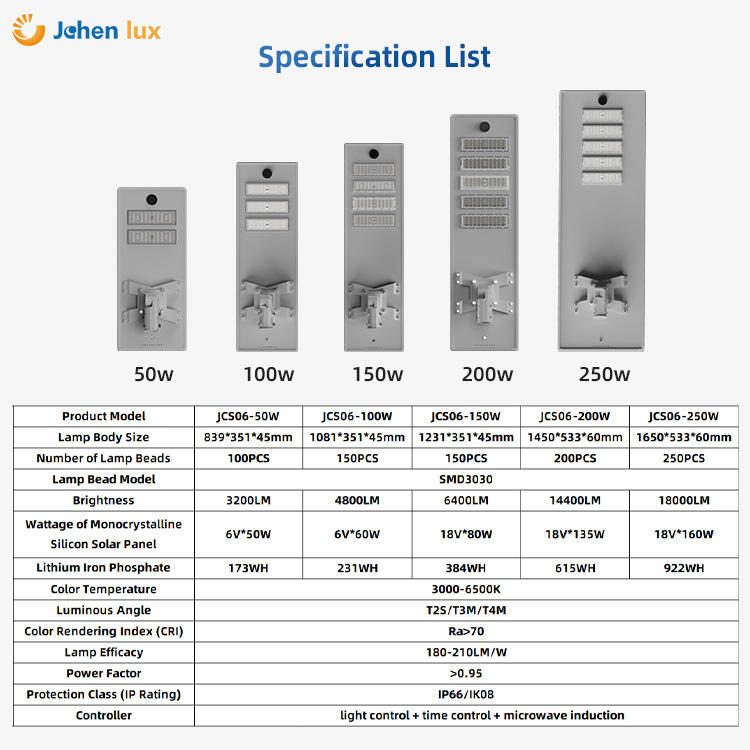
Safety and service life are core demands that affect infrastructure operation safety. Wired street lights face risks of electric leakage, short circuit and line fire disasters after long-term wind and rain erosion. Poorly sealed solar lights are prone to water ingress, circuit corrosion and component burnout. Standard all-in-one solar street lights adopt fully enclosed waterproof and dustproof design, with lightning protection, overcharge protection, overdischarge protection and short circuit protection functions. They run safely 24 hours a day without hidden electrical hazards, perfectly matching unattended long-term outdoor lighting applications.
Performance Comparison Of Ordinary Street Lights & Premium Integrated Solar Street Lights
| Comparison Item | Traditional Mains Street Light | Low-quality Solar Street Light | High-grade All-in-One Solar Street Light |
|---|---|---|---|
| Power Supply Mode | Complicated Cable Wiring | Separate Panel & Battery Integrated | High-efficiency PV Independent Power Supply |
| Annual Electricity Cost | Extremely High | Low In Short Term | Almost Zero Long-term Cost |
| Weather Resistance | Poor In Wind & Rain | Unstable In Cloudy Days | Excellent In All Complex Weather |
| Service Life | 3–5 Years | 1–2 Years | 5–8 Years Stable Operation |
| Installation Cost | High Labor & Material Cost | Moderate Construction Cost | Simple Installation, Low Overall Cost |
| Fault Rate | Frequent Line Failures | High Battery & Light Attenuation | Extremely Low Natural Fault Rate |
Most users only focus on initial purchase price when selecting outdoor lighting products, ignoring total life cycle cost. Although low-priced lamps seem economical at first purchase, frequent replacement, frequent maintenance and shortened service life make the comprehensive cost far higher than high-quality solar street lights. Roads, squares, scenic spots and residential areas require stable, durable and low-maintenance lighting, which cannot be replaced by rough and shoddy products.
Intelligent human-induction function further optimizes actual use experience. The lamp automatically brightens when people pass by and dims during idle periods, greatly extending battery endurance and working hours. It no longer wastes electric energy on unnecessary high-brightness lighting all night, balancing lighting safety and energy saving perfectly. This humanized design is widely recognized in rural road reconstruction, community night lighting and park safety lighting projects.
Long-term outdoor use also puts strict requirements on corrosion resistance and aging resistance. Outdoor lamps are exposed to ultraviolet radiation, humidity changes and sand erosion all year round. Shell materials with poor quality will crack, fade and deform quickly, damaging internal circuits. Reliable solar street light shells use high-strength weather-resistant engineering plastics, resisting UV aging and outdoor corrosion effectively, keeping complete appearance and stable performance for many years.
In summary, excellent solar street lighting products solve fundamental pain points including high energy consumption, difficult construction, poor weather adaptability and short service life. Reasonable selection of integrated solar street lights can help engineering projects reduce investment, lower later operation burden and improve nighttime safety level. Stable, efficient and durable solar outdoor lighting has become the mainstream inevitable choice for modern green infrastructure construction.